
The Seductive Charm of Invasive Spotted Lanternflies: Correlates of Female Attractiveness
Angel Ihie
Co-Presenters: Eliani Arrue
College: The Dorothy and George Hennings College of Science, Mathematics and Technology
Major: Biology
Faculty Research Mentor: Brenna Levine
Abstract:
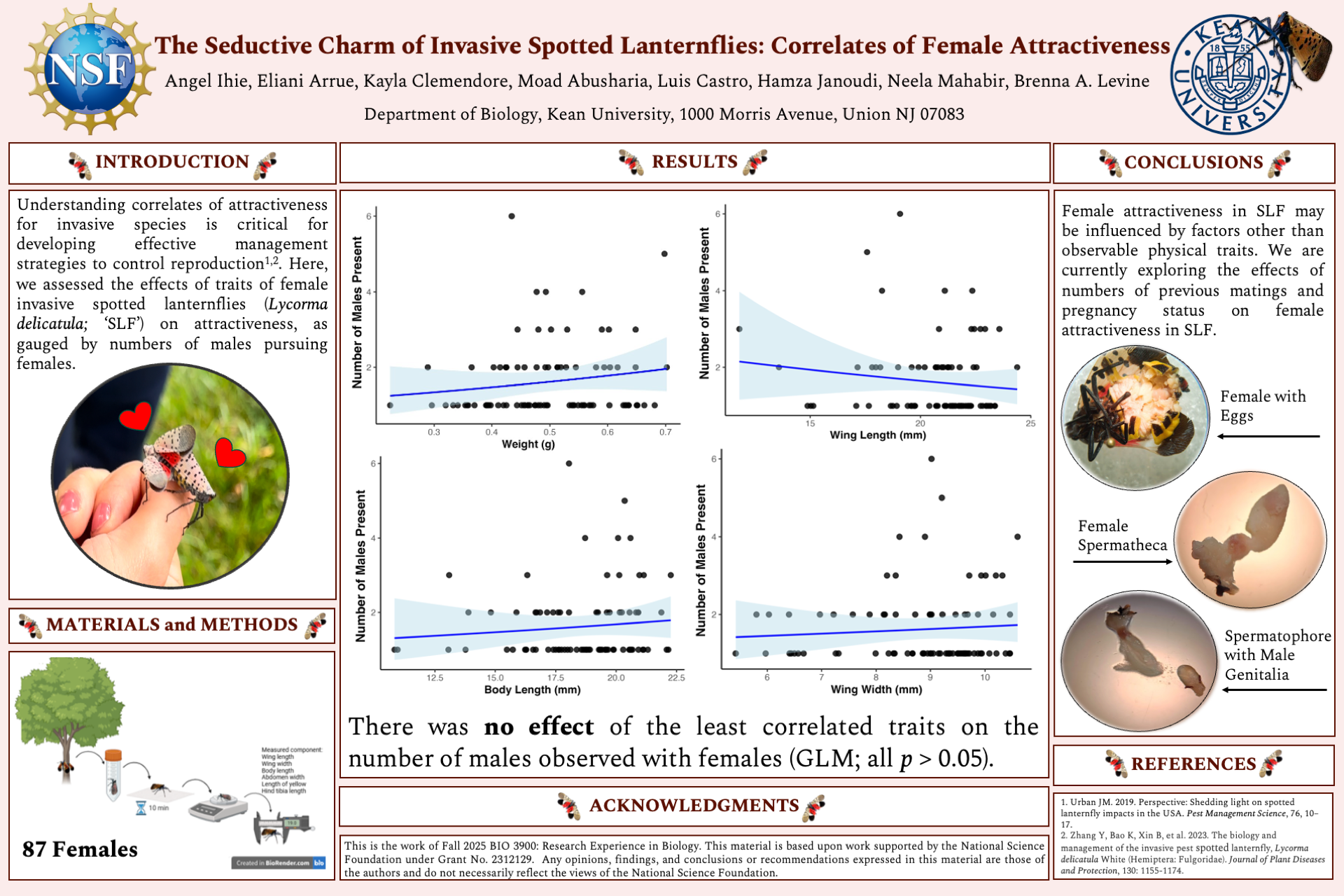
Invasive species threaten ecosystems and economies, and understanding their mating systems can inform control efforts. In invasive spotted lanternflies (Lycorma delicatula), we lack an understanding of why males select their mates, a behavior that influences reproductive output and population growth. Here, we tested the hypothesis that males select mates based on female morphological trait values and/or reproductive status. In Fall 2024, we observed adult female spotted lanternflies (n = 90) being courted by males on Kean University’s (Union, NJ) campus. For each female, we recorded the number of attendant males (i.e., a measure we used as a proxy for attractiveness) and collected and preserved the female. We then measured characteristics of each female including wing length, wing width, body length, abdomen length, hind tibia length, and length of the yellow abdominal patch (i.e., a potential indicator of pregnancy status) using digital calipers. Finally, we used regression models to test for relationships between female traits and number of male attendants. Contrary to our expectations, we found only weak positive correlations between the female trait values and the number of males attendants. Thus, our data indicate that males are not choosing mates based on morphological traits. We are currently dissecting the female spotted lanternflies to determine whether mated status is a predictor of attractiveness.