
Health Monitoring via RFID-based Cardiac Motion Tracking System
Alejandro Chavez-Mayoral
Co-Presenters: Individual Presentation
College: The Dorothy and George Hennings College of Science, Mathematics and Technology
Major: Computer Science
Faculty Research Mentor: Daehan Kwak
Abstract:
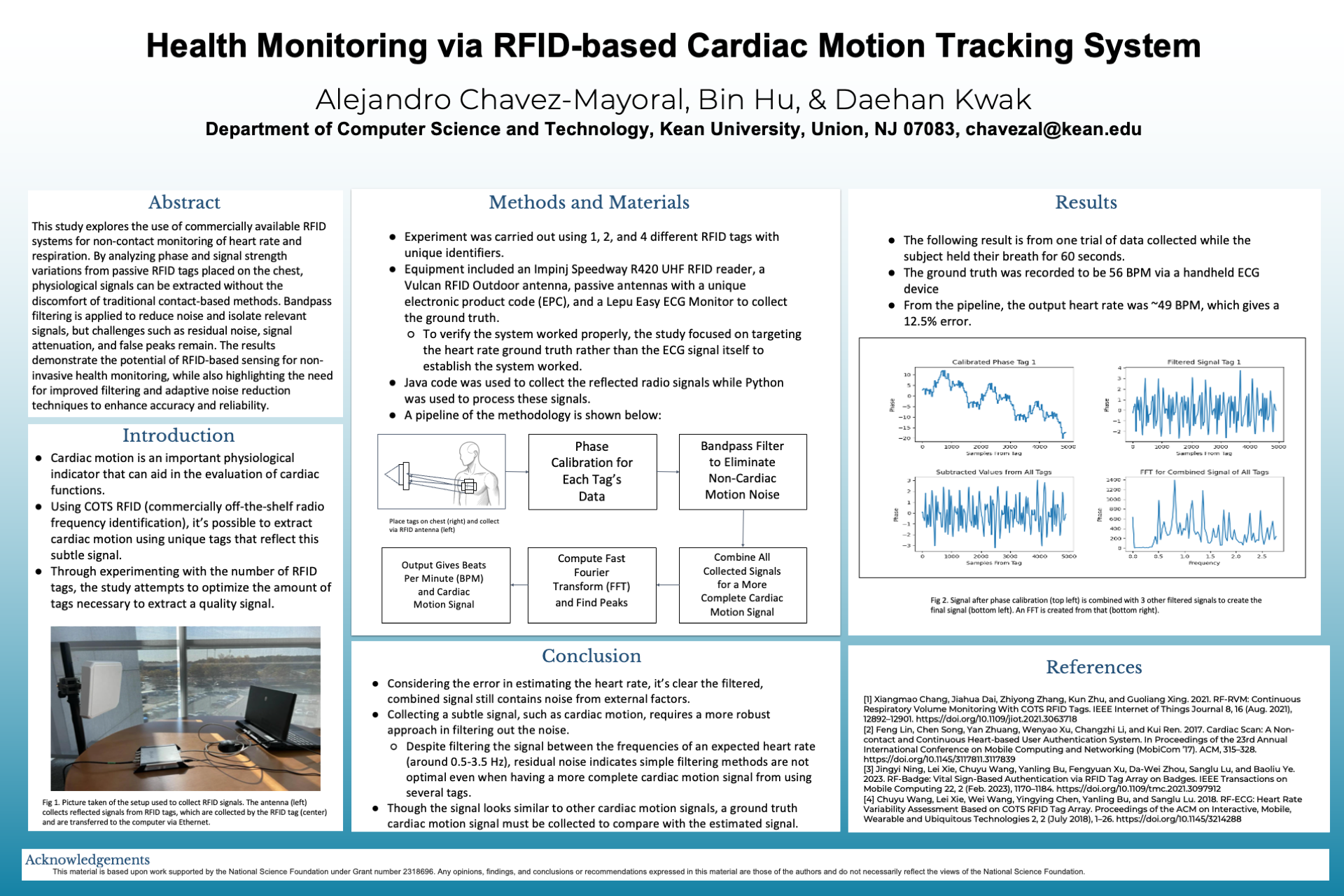
Monitoring physiological biomarkers such as heart rate and respiration is crucial for assessing a patient’s health, yet traditional contact-based methods can be intrusive and uncomfortable. This study explores the feasibility of using commercially available RFID (COTS RFID) systems for non-contact breath and cardiac motion monitoring. By analyzing the phase and signal strength variations of passive RFID tags placed on the chest, we extract physiological signals while addressing challenges such as noise interference, signal attenuation, and phase calibration. A bandpass filtering technique is applied to refine the extracted signal; however, residual noise and false peaks indicate the need for further signal process-ing enhancements. The findings suggest that while RFID-based monitoring shows promise for non-contact physiological sensing, improvements in filtering techniques and adaptive noise reduction are necessary to enhance accuracy and reliability.