
Journaling Through a Reflective Lens: A Thematic Analysis of College Students’ Concerns Expressed in Reflective and Standard Journaling Conditions
Louly Kaplan
Co-Presenters: Ashley Taylor, Hannah Blum, Shira Pollack, Jonah McManus, Charlie Moreno
College: The College of Health Professions and Human Services
Major: School and Clinical Psychology (Psy.D)
Faculty Research Mentor: Jennifer Lerner
Abstract:
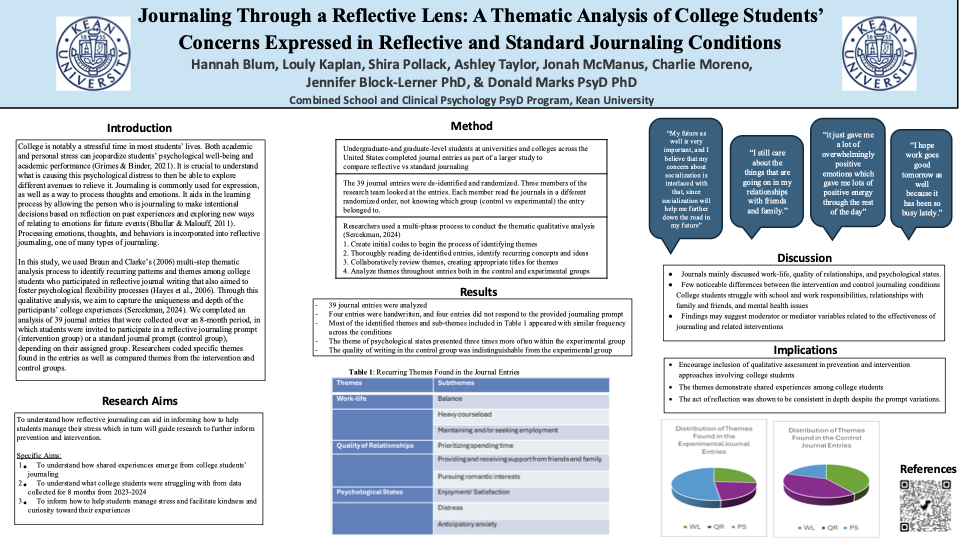
College is notably a stressful time in most students’ lives. Both academic and personal stress canjeopardize students’ psychological well-being and academic performance (Grimes & Binder,2021). It is crucial to understand what is causing this psychological distress to then be able toexplore different avenues to relieve it. Journaling is commonly used for expression, as well as away to process thoughts and emotions. It aids in the learning process by allowing the person whois journaling to make intentional decisions based on reflection on past experiences and exploringnew ways of relating to emotions for future events (Bhullar & Malouff, 2011). Processingemotions, thoughts, and behaviors is incorporated into reflective journaling, one of many typesof journaling. In this study, we aim to use Braun and Clarke’s (2006) six-step thematic analysisprocess to identify recurring patterns and themes among college students who participated inreflective journal writing that also aimed to foster psychological flexibility processes (Hayes etal., 2006). Through this qualitative analysis, we aim to capture the uniqueness and depth of theparticipants’ college experiences (Sercekman, 2024). An analysis of 39 journal entries that havebeen collected over an 8-month period where students were invited to participate in a reflectivejournaling prompt (intervention group) or a standard journal prompt (control group) will becompleted. Researchers will code specific themes found in the entries as well as compare themesfrom the intervention and control group. Preliminary exploration of the journal entries indicatesthemes such as psychological distress, quality of relationships, and work-life balance. We expectthe results to show a difference between groups in depth and orientation to distress. Results canhelp inform how to help students manage their stress as well as guide research to further inform prevention and intervention.