
The Social Media X Effect on Closed-End Funds
Xinrui Shi
Co-Presenters: Individual Presentation
College: College of Business and Public Management
Major: Accounting
Faculty Research Mentor: Nazif Durmaz
Abstract:
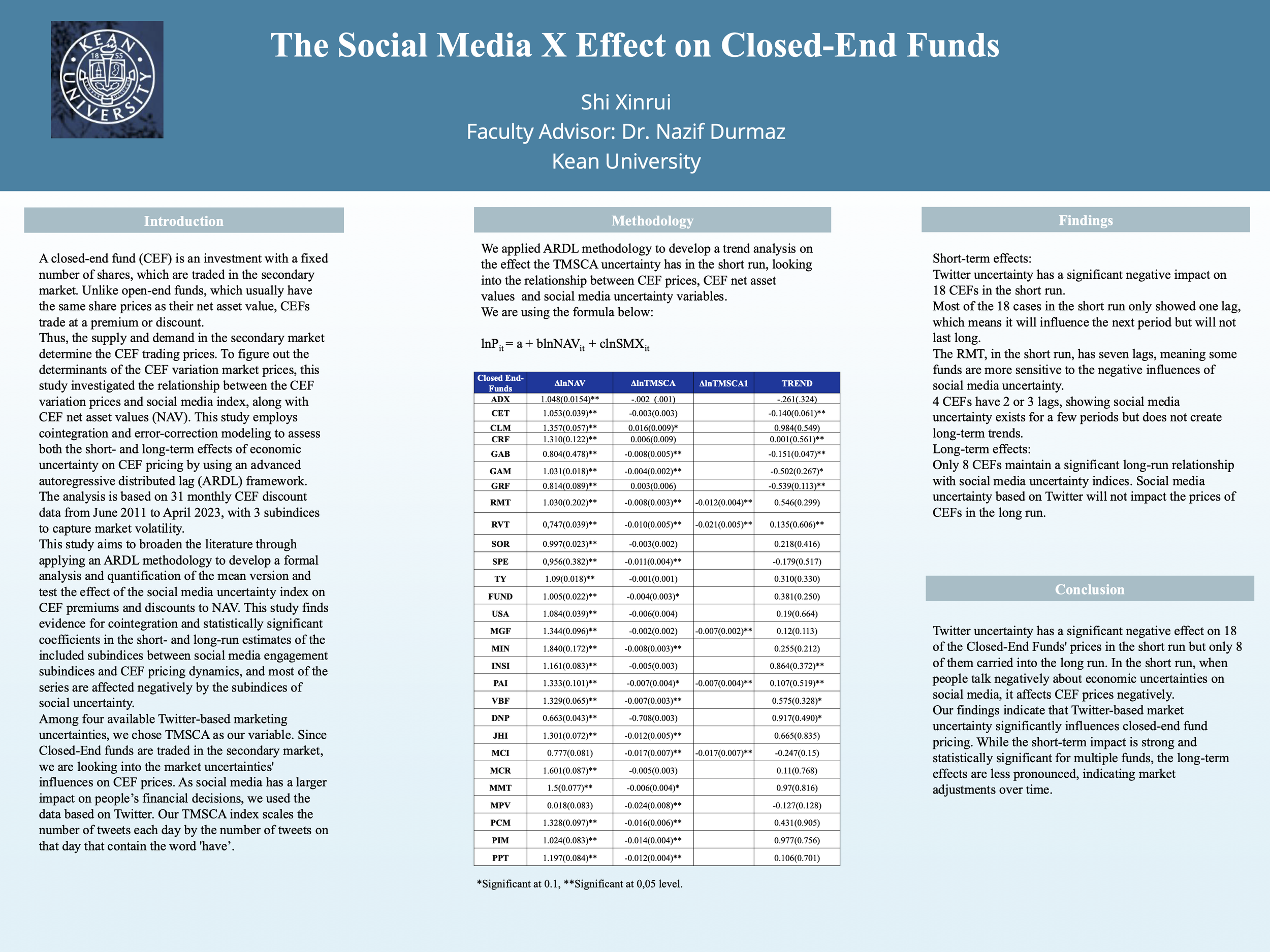
A closed-end fund (CEF) is an investment with a fixed number of shares, which are traded in the secondary market. Unlike open-end funds, which usually have the same share prices as their net asset value, CEFs trade at a premium or discount. Thus, the supply and demand in the secondary market determine the CEF trading prices. To figure out the determinants of the CEF variation market prices, this study investigated the relationship between the CEF variation prices and social media index, along with CEF net asset values. This study employs cointegration and error-correction modeling to assess both the short- and long-term effects of economic uncertainty on CEF pricing by using an advanced autoregressive distributed lag (ARDL) framework. The analysis is based on 31 monthly CEF discount data from June 2011 to April 2023, with 3 subindices to capture market volatility. This study aims to broaden the literature through applying an ARDL methodology to develop a formal analysis and quantification of the mean version and test the effect of the social media uncertainty index on CEF premiums and discounts to NAV. This study finds evidence for cointegration and statistically significant coefficients in the short- and long-run estimates of the included subindices between social media engagement subindices and CEF pricing dynamics, and most of the series are affected negatively by the subindices of social media uncertainty.