
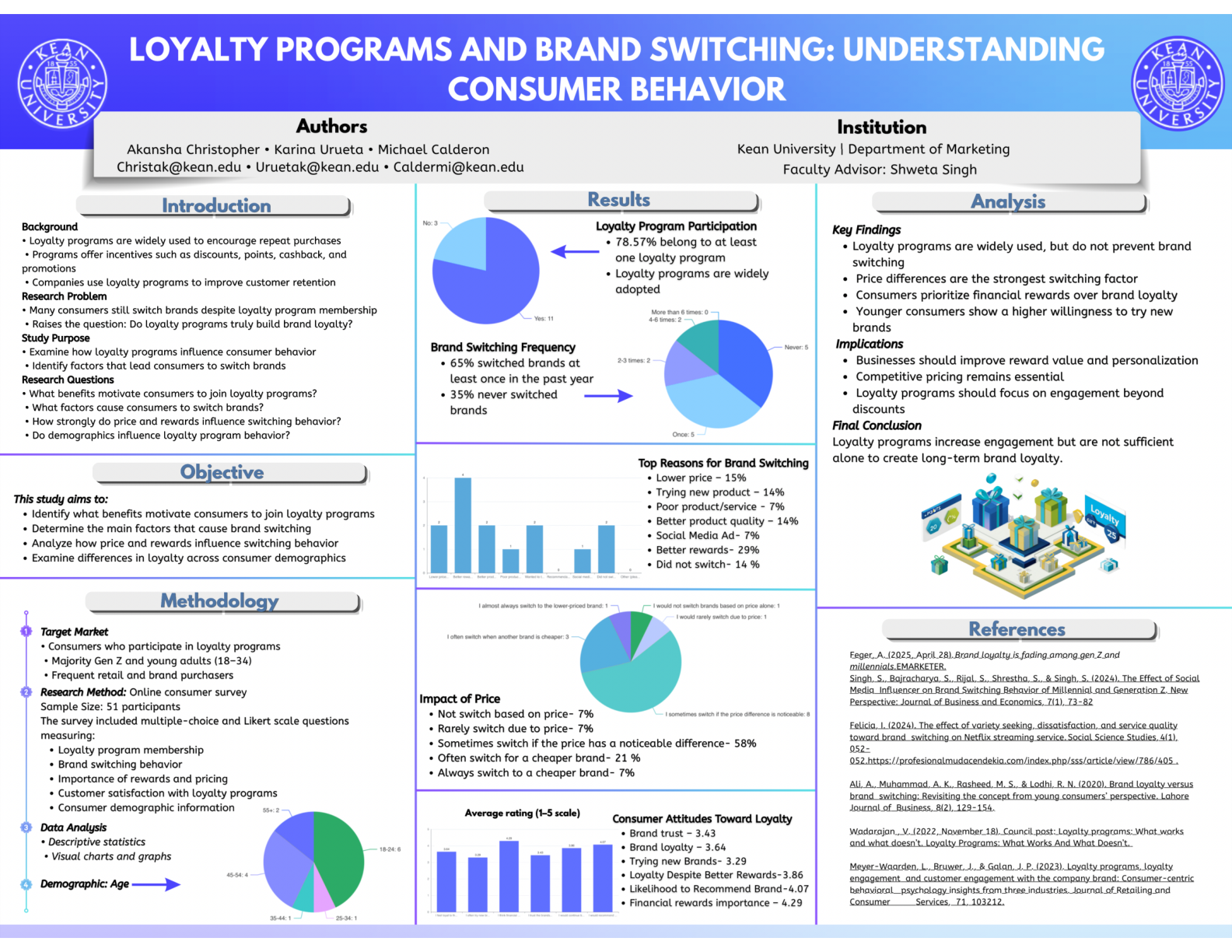
Do Loyalty Programs Really Prevent Brand Switching?
Karina Urueta
Co-Presenters: Michael Calderon, Akansha Christopher
College: College of Business and Public Management
Major: BS.MARKETING
Faculty Research Mentor: Shweta Singh
Abstract:
Every day, millions of consumers purchase products at discounted prices, receive rewards, or are notified of upcoming promotions through company Loyalty Programs. These programs play a major role in shaping Consumer Behavior, influencing how customers perceive value and decide where to shop. While Loyalty Programs are widely used across industries, questions remain about how effective they truly are in strengthening Customer Retention and preventing Brand Switching. Many consumers can easily download an app, take advantage of first-time Incentives, and then move on to a competitor offering similar rewards. This pattern of Brand Switching raises concerns about whether Loyalty Programs foster genuine brand loyalty or simply encourage short-term engagement driven by Incentives rather than long-term commitment.The primary goal of this study is to identify which Incentives are most effective in influencing Consumer Behavior, strengthening Customer Retention, and reducing Brand Switching. Additionally, the study will examine the underlying motivations that drive Consumer Behavior when customers decide to remain loyal or switch brands. To address these objectives, a mixed-methods approach will be employed, with surveys serving as the primary data source and potential qualitative interviews providing deeper insight into Consumer Behavior patterns. Although nearly any company can implement Loyalty Programs, only those that strategically design Incentives to promote Customer Retention are able to achieve sustainable growth. Without meaningful engagement strategies that account for Consumer Behavior, companies risk wasting resources, as short-term promotional gains are unlikely to produce long-term success or prevent Brand Switching.Keywords: Loyalty Programs, Brand Switching, Customer Retention, Consumer Behavior, Incentives